













In our latest blog, Tim Pearson looks at streaming piracy from a different lens, focusing on digital trust, consumer risk, and the future of subscriber protection and why it’s becoming a critical priority for operators, rights holders and technology providers alike.
In previous posts looking at the risks and cost of streaming piracy, I’ve always come at it from a content protection angle; focusing on lost revenues, the impact on broadcasters, streaming services and rights holders. While highly valid and arguably one of the biggest topics our industry faces today, this is only part of the story.
Two years ago, we launched our ground-breaking Inside the Mind of a Pirate series where we interviewed a pay-TV pirate and asked them about their motivations. This year, we interviewed another convicted pirate and this time, one that had been involved in the distribution of illegal streaming boxes in the US state of Pennsylvania. What transpired was both revealing and alarming. While ‘dodgy streaming sticks’ are universally discussed, rarely has anyone explored what’s really going on within the silicon and the impact that this can have on consumers.
Behind the promise of “free TV” sits a sophisticated network of criminal operators, technologies and business models built to distribute content outside of legitimate channels. The low to no price point may attract consumers but it’s the streaming device itself that presents the real risk. To put this into context, our pirate was part of a distribution network selling a globally available (and illegal) set-top box. In 2025 alone, 105 containers of these set-top boxes arrived in the US, each containing 2.6 million boxes that generated revenue of around USD$525 million. All from just one pirate service in the US.
But that’s just the start. As connected homes continue to expand, the decision to install a pirate streaming box can have consequences far beyond copyright infringement. What begins as a piracy problem can quickly become a cybersecurity problem, exposing consumers, households and legitimate service providers to risks that they may never have considered.
Looking Beyond the Stream
Illegal streaming services are not simply unofficial versions of legitimate platforms. Unlike trusted consumer products and legitimate services, pirate ecosystems operate outside of established security frameworks, bypassing software governance processes and accountability structures. Their primary objective is revenue for content, not consumer protection.
For consumers, the experience often appears straightforward. In our latest pirate interview, we learned consumers could purchase the box for USD$325 when they went to their local barbershop. They then took it home, unpacked it from its professional-grade packaging, connected it to their TV, booted it up, hit the ‘I agree’ button and gained access to thousands of channels, premium sports events and subscriptions services—all for zero ongoing cost. The consumer sits back, believes it all to be genuine and tells their friends about the deal which then spreads exponentially across social networks.
What is less visible however, is the infrastructure operating behind the scenes and the level of trust that the consumer has unwittingly placed in unknown hardware, software and a rogue service provider. Admittedly, consumers rarely know who has developed the service application, where the content originates, how the device is maintained, whether software updates are verified, or who ultimately controls the services running on the device but, through a legitimate provider effective trust allays any concerns. With a pirate service, that same level of trust cannot be assumed.
The Pirate Box Has Become the Weakest Link
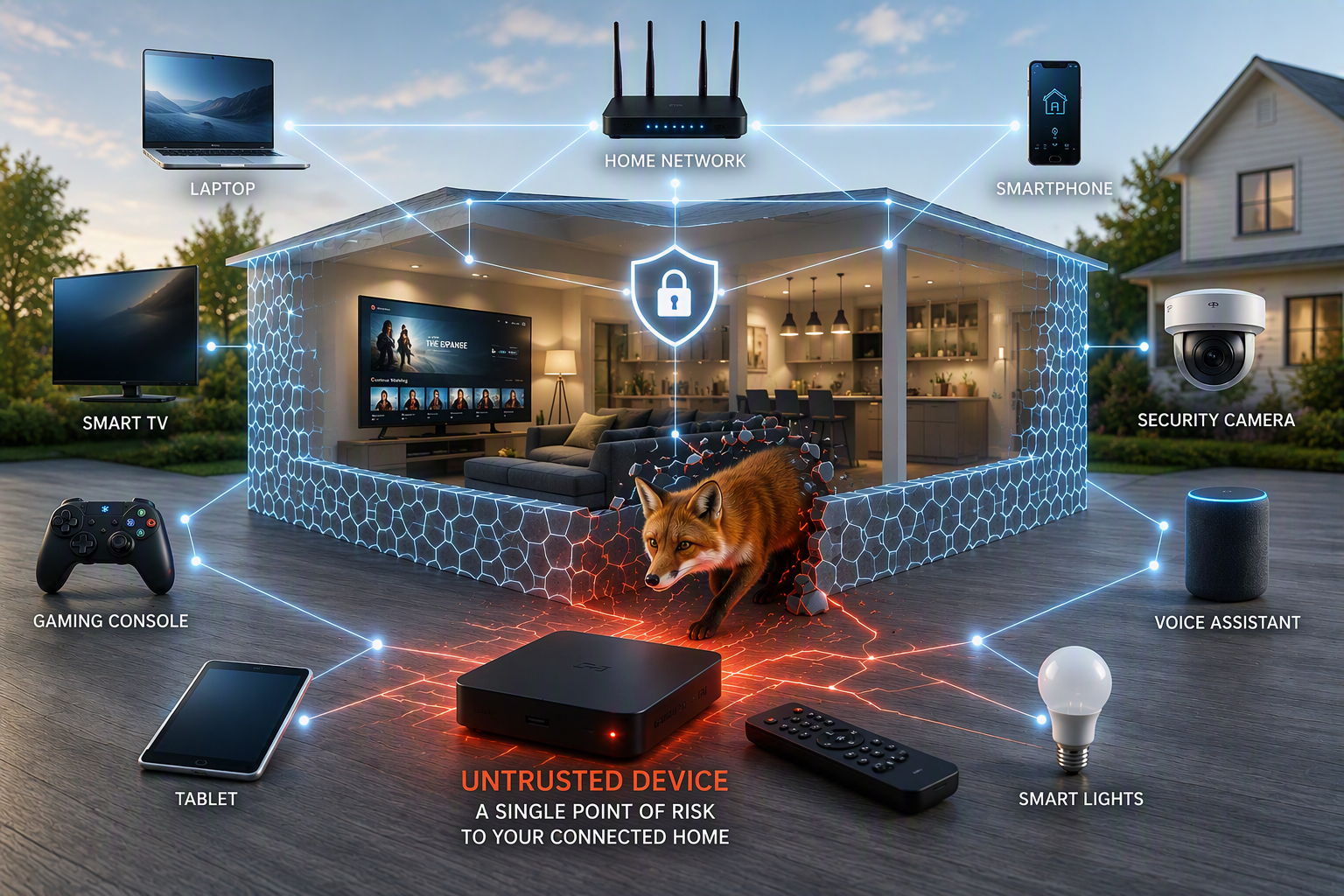
Today’s home is no longer just a collection of devices, it is a digital ecosystem.
Smartphones, laptops, tablets, gaming consoles, smart televisions, voice assistants, security cameras, connected toys, appliances and home working equipment all share the same broadband connection and router.
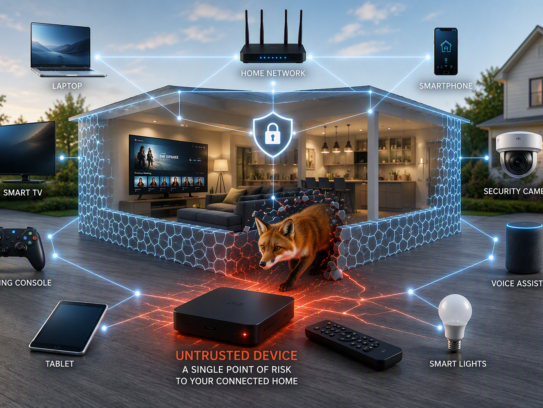
Introducing a pirate streaming device into that environment effectively introduces a new and untrusted participant into the home and onto the network. A digital fox in a connected henhouse.
Recent cybersecurity investigations have highlighted instances where unofficial streaming devices contained malware, required users to bypass recognized security protections to get the device online, connected to unofficial application stores or participated in botnet and proxy-network activity without the users’ knowledge. In practical terms this means that consumers are not simply just connecting a video player. They may be connecting a device that can communicate with unknown services, introduce vulnerable software into the network or create new pathways for malicious activity. NAGRAVISION’s own research has identified that illegal devices may facilitate illicit access onto the home network where remote access can then alter settings on the home router to allow malicious actors to breach existing security and gain access to digital devices within the home.
The irony is that many consumers install these devices to save money, without realizing they may be placing personal information, online accounts, payment details, and digital privacy at significantly greater risk.
The Connected Home is Becoming a New Battleground
The challenge though, goes beyond a single device.
Consumers frequently assume that their broadband provider, antivirus software or router will automatically protect them from every threat but once an untrusted device gains access to a household network, the potential impact extends to every connected device in the home. Sensitive information, family activity, photographs, browsing behavior and connected services, have all become fair game for digital intruders.
This redefines the challenge. Piracy can no longer be viewed solely as an issue of content theft and lost revenue. It increasingly sits at the intersection of consumer safety, privacy and digital trust. What begins with a search for free content can ultimately expose consumers to a much wider set of risks.
Piracy is Becoming a Trust Problem
Historically, piracy has been viewed as a battle between content owners and illegal distributors.
Today, the consequences are broader.
When consumers experience malware infections, service disruptions, phishing attacks or online fraud, they rarely distinguish between the source of the problem and the provider of the connectivity; they expect reliability, safety and trust. The most successful operators of the future will not simply just provide connectivity, they will help subscribers navigate an increasingly complex digital world, providing the intelligence, protection and confidence needed to live safely online.
Trust is rapidly becoming one of the most valuable services a provider can deliver.
A Converging Future
Perhaps the most important lesson from examining today’s piracy ecosystem is that traditional boundaries are disappearing. Piracy is no longer just a media and entertainment issue any more than cybersecurity is no longer just an IT issue. Digital trust now sits at the intersection of both.
The same ecosystem that distributes illegal content can, at the same time, create more risks for consumers. The same operators seeking to protect content value are increasingly being asked to protect subscriber trust. The same intelligence used to identify piracy activity can help reveal broader patterns of digital risk.
That convergence creates an opportunity for the industry to rethink the conversation.
Instead of viewing piracy solely as lost revenue, organizations can begin to recognize its wider impact on consumer safety, digital trust and connected-home security. Because today’s pirate streaming box is not just a way of accessing cheap or free versions of legitimate content, it can represent the first point of compromise inside the connected home.
And that makes piracy not just a content problem, but a consumer protection challenge, giving service providers yet another reason to make fighting piracy a priority.
To Learn More
NAGRAVISION is helping operators and rights holders address the evolving risks of piracy through a dual approach. NAGRA Venturi delivers the intelligence-led visibility needed to understand and disrupt piracy ecosystems, while NAGRA Scout helps protect subscribers from the cybersecurity threats that can emerge when untrusted devices and services enter the connected home. Here, NAGRA Scout changes the game. by helping service providers respond with protection that is intelligent, effective and crucially, non-intrusive and easy to deploy. It leverages industry-leading threat intelligence without disrupting existing networks or customer experiences and, by turning complex, multi-source cyber threats into a trusted, operator-delivered service, NAGRA Scout helps keep consumers safe from the risks that matter most. This approach ensures action isn’t taken after the damage is done but prevents the attack from happening in the first place.
To learn more about NAGRA Venturi and/or NAGRA Scout, book a meeting at Network X or get in touch, we look forward to continuing the conversation.